How Great Leaders Think: The Art of Reframing by Lee G. Bolman & Terrence E. Deal
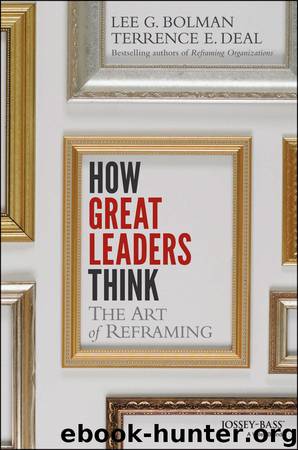
Author:Lee G. Bolman & Terrence E. Deal
Language: eng
Format: mobi
ISBN: 9781118282236
Publisher: Wiley
Published: 2014-07-07T14:00:00+00:00
CULTURAL REVIVAL AT STARBUCKS
As he sat at his kitchen table early one morning in February 2007, Starbucks chairman and former CEO Howard Schultz was enveloped in the gloom of the Seattle weather outside his window. Until recently, his company had enjoyed extraordinary growth and profitability, but now it was showing signs of decline. Customers were spending less, growth was slowing, and the share price had plunged by more than 40 percent. When he visited individual stores, Schultz felt that “something intrinsic to the Starbucks brand was missing. An aura. A spirit. At first, I couldn’t put my finger on it. No one thing was sapping our stores of a certain soul. Rather the unintended consequences resulting from the absence of several things that had distinguished our brand were, I feared, silently deflating it.”5
The Memo
Schultz began to organize his thoughts on a yellow legal pad in a handwritten memo titled “The Commoditization of the Starbucks Experience.” In it, he noted recent technical advances that were undercutting key cultural values and ways. Automatic espresso machines increased speed, consistency, and service, but eroded the mystique of the barista as a key element in the Starbucks aura of theater and romance. Sealed bags kept coffee fresher, but customers could no longer enjoy the experience and aroma of seeing or smelling it as it was ground. Streamlining and standardizing store design gained efficiencies of scale but sacrificed some of the “cozy coffee bar” ambience of the past.
Schultz ended the memo with a heartfelt statement: “We desperately need to get back to the core and make the changes necessary to evoke the heritage, the tradition, and the passion that we all have for the true Starbucks Experience.”6
The Uproar
Schultz intended the memo as confidential food for thought for key executives, but, to his chagrin, someone leaked it. As it went viral across the Internet and the media, it set off a raucous debate inside the company. Some at Starbucks strongly disagreed with Schultz: Wasn’t the coffee merchant the most visited retailer in the world? Others were confused or insulted. They were working hard to make the company better: Was Schultz saying they weren’t doing their jobs? Still others felt that Schultz was speaking truths that needed to be told and debated.
Schultz was stunned by the leak and felt pressure to do damage control. But the memo expressed his passion for Starbucks, and he hoped it would generate a productive dialogue. Over the next several months, his concerns about the company’s direction continued to grow. His heart sank when he walked into Starbucks stores and felt that they were no longer celebrating coffee. This violated his conviction that a true merchant creates magic and tells a story that envelops customers as they enter a shop. Months went by, and Schultz felt that nothing substantial was changing in the company or the stores. “Day by day my disappointment edged toward anger, and at times fear, that Starbucks was losing its chance to get back the magic.”7 By the end of the year, same-store sales started to show double-digit declines.
Download
This site does not store any files on its server. We only index and link to content provided by other sites. Please contact the content providers to delete copyright contents if any and email us, we'll remove relevant links or contents immediately.
Hit Refresh by Satya Nadella(9188)
The Compound Effect by Darren Hardy(9056)
Change Your Questions, Change Your Life by Marilee Adams(7847)
Nudge - Improving Decisions about Health, Wealth, and Happiness by Thaler Sunstein(7758)
The Black Swan by Nassim Nicholas Taleb(7197)
Deep Work by Cal Newport(7162)
Rich Dad Poor Dad by Robert T. Kiyosaki(6727)
Principles: Life and Work by Ray Dalio(6602)
Daring Greatly by Brene Brown(6557)
Playing to Win_ How Strategy Really Works by A.G. Lafley & Roger L. Martin(6501)
Man-made Catastrophes and Risk Information Concealment by Dmitry Chernov & Didier Sornette(6139)
Digital Minimalism by Cal Newport;(5837)
Big Magic: Creative Living Beyond Fear by Elizabeth Gilbert(5833)
The Myth of the Strong Leader by Archie Brown(5552)
The Slight Edge by Jeff Olson(5463)
Discipline Equals Freedom by Jocko Willink(5425)
The Laws of Human Nature by Robert Greene(5325)
The Motivation Myth by Jeff Haden(5244)
Stone's Rules by Roger Stone(5130)
